Warsaw residents
Recovered heat powers the district heating network, reducing heating costs and carbon footprint.
- Lower CO₂ emissions in building heating
- Stable heat supply without additional combustion
- Better air quality in the city

WasteLessDHS is an innovative project that converts waste heat from data centers into energy for Warsaw's district heating system.
15 MW of recovery, zero additional combustion.
Data centers generate significant amounts of waste heat. WasteLessDHS technology captures it and transports it to the district heating network, powering thousands of apartments in Warsaw.
Servers generate heat as a byproduct. Instead of dissipating it to the atmosphere, the system captures the energy.
An industrial heat pump system increases the temperature of the low-potential heat to the level required by the district heating network.
The recovered heat is transferred to the Veolia Energia Warszawa district heating network, powering households and public utility buildings.
The project provides the heat energy equivalent for approximately 200 households, reducing CO₂ emissions by about 15,642 tons annually.
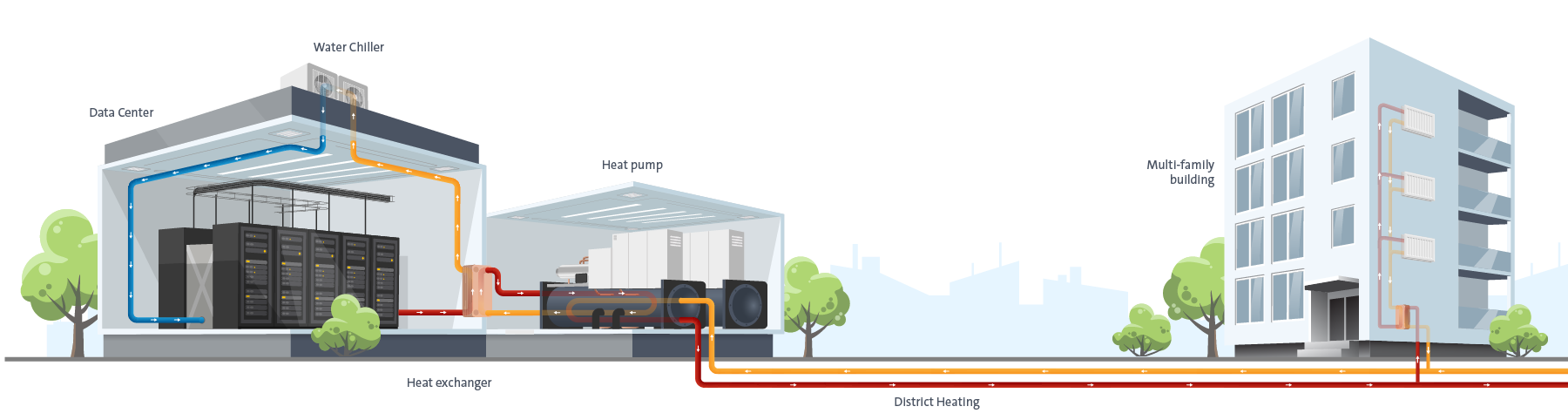
Recovered heat powers the district heating network, reducing heating costs and carbon footprint.
The project avoids the emission of over 15,000 tons of CO₂ annually by utilizing waste heat.
Funded by the EU Innovation Fund, the project sets a standard for data center heat recovery for Europe.
Supplying waste heat to the network lowers operational costs and strengthens the data center operator's ESG profile.
EU Credibility and Compliance
The WasteLessDHS (Waste Less District Heating System) project is an initiative to recover waste heat from data centers and supply it to the municipal district heating network in Warsaw.
The project involves designing, building, and commissioning a 15 MW installation based on heat pumps between the data center cooling system and Veolia’s district heating network. The installation is intended to supply heat to the network for at least 10 years from commissioning.
Implementation is in line with the European Green Deal and EU climate goals for 2030.
The WasteLessDHS project has received a grant from the European Union’s Innovation Fund program (agreement No. 101252183). Funding amount: EUR 2,808,500.Funded by the European Union. Views and opinions expressed are however those of the author(s) only and do not necessarily reflect those of the European Union or the European Climate, Infrastructure and Environment Executive Agency (CINEA). Neither the European Union nor the granting authority can be held responsible for them.